
Whether you want to back up all your precious files, make it easier to share and collaborate, or create your own entertainment cloud, network-attached storage (NAS) devices are the way. These versatile servers can boost your home network and help you offload tasks from your computer and other devices.
I’ve spent the last few months testing NAS devices from some of the top brands with a focus on families looking to create backups and maybe spin up an entertainment server to cut back on streaming subscriptions. These are the NAS devices I recommend.
You might want to check out our related guides too, like How to Set Up an NAS Server, How to Back Up Your Digital Life, and The Best External Hard Drives.
The NAS Servers I Recommend Most
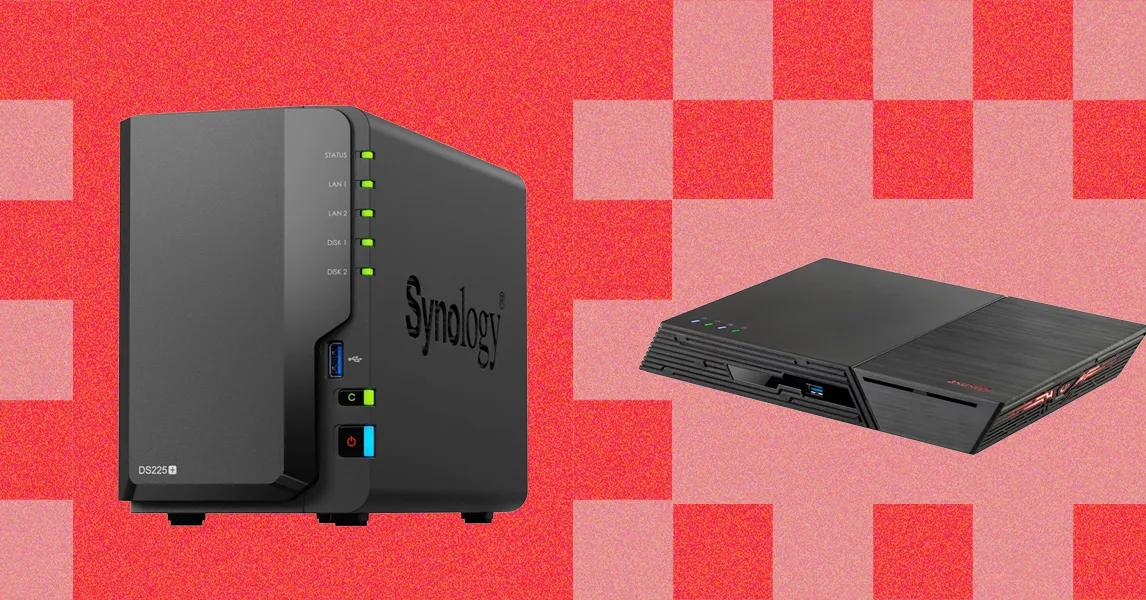
While no longer undisputed, Synology is still the heavyweight champion of the NAS market, and this two-bay NAS is ideal for the average home. It is extremely fast, either topping the charts or coming close in my tests, and consistently hitting around 300 MB/s read and 250 MB/s write, though that drops to a little over 100 MB/s if your network is limited to 1 Gbps anywhere (router, port, cable, or switch). It has a generous array of ports (2.5-Gbps and 1-Gbps Ethernet ports and USB ports front and back). The excellent hardware includes a speedy Intel Celeron J4125 quad-core processor, 2 GB of RAM that can be upgraded to 6 GB, and space for two drives (up to 40 TB). It is compact and relatively quiet, with some minor fan noise when it’s busy. The screwless clip-on tray design makes it quick to insert drives.
Setup and configuration are simple and accessible. Synology’s software, through its web interface and mobile apps, is the most polished and user-friendly I’ve tested, and Synology offers the largest selection of apps (both its own polished offerings and third-party apps like Plex and Jellyfin). This NAS offers tons of flexibility for backups, works great as a media server, and offers a lot of extras, including VPN server and security camera support.
On the downside, Synology’s devices are relatively expensive. Remember that, as on most NAS devices, you must provide your own drives. Synology also briefly locked down its NAS lineup to Synology drives, deeming third-party drives incompatible. While it has rolled this back after some protest, so you can use third-party drives now, it’s a bit of a red flag. There’s also no HDMI port here, which you might want for connecting a TV. If you think you need more space, the Synology DiskStation DS425+ ($520) adds an extra two bays.
For folks seeking a simple network backup that doesn’t require much thought or configuration, I also tested the all-in-one Synology BeeStation Plus, which comes with storage included (prices are currently inflated due to the AI-driven shortage), but no apps or additional features. It’s quick and easy to set up, works fine for automatic backups, and has a decent photo app that can recognize faces, but the performance is middling.
The regular Synology BeeStation ($365) is a bit more affordable, but only has half the space at 4 TB. For a straightforward backup solution, the BeeStation is as easy as it gets, but you can get more for your money.
Synology offers a very wide range of NAS devices, including powerful systems for big businesses. It also makes good routers that can be paired to form a mesh and security cameras that I have not yet tested.